A Crash Course in Employee Benefits and the PEO Solution

John Crochet • September 7, 2023

Employee benefits are a critical aspect of attracting and retaining top talent in today's competitive job market. For businesses, navigating the complex world of benefits can be overwhelming. That's where Professional Employer Organizations (PEOs) come into play. In this crash course, we'll explore the basics of employee benefits and how partnering with a PEO can simplify and optimize your benefits offerings.


The Basics of Employee Benefits


Employee benefits are non-wage compensations provided to employees in addition to their salaries or wages. These benefits can take various forms, and they play a crucial role in fostering employee satisfaction, well-being, and overall job satisfaction. Here are some common types of employee benefits:


  1. Health Insurance: One of the most sought-after benefits, health insurance covers medical expenses, including doctor visits, hospital stays, and prescription drugs.
  2. Dental and Vision Insurance: These plans provide coverage for dental and eye care services, offering employees preventive and corrective options.
  3. Retirement Plans: 401(k) plans and similar retirement benefits help employees save for their future, often with employer contributions.
  4. Life and Disability Insurance: These benefits provide financial protection to employees and their families in case of unexpected events.
  5. Paid Time Off (PTO): Paid vacation days, sick leave, and holidays ensure that employees can take necessary breaks and manage personal matters without financial stress.
  6. Flexible Spending Accounts (FSAs) and Health Savings Accounts (HSAs): These accounts allow employees to set aside pre-tax dollars for medical and childcare expenses.
  7. Wellness Programs: Employers may offer wellness initiatives like gym memberships, nutrition programs, or mental health support to promote employee well-being.


The PEO Solution for Employee Benefits


While offering a comprehensive benefits package is essential for attracting and retaining top talent, managing these benefits can be complex and time-consuming. This is where partnering with a PEO can make a significant difference. Here's how a PEO can simplify and optimize your employee benefits:


  1. Access to Group Benefits: PEOs can provide access to group health, dental, vision, and retirement plans, often at more competitive rates due to their collective bargaining power.
  2. Administrative Support: PEOs handle the administrative tasks associated with benefits, from enrollment and compliance to claims management and reporting.
  3. Customization: PEOs work with you to tailor benefit plans that align with your employees' needs and your budget, ensuring a win-win situation.
  4. Compliance Expertise: Staying compliant with ever-changing benefits regulations is a daunting task. PEOs have dedicated experts to keep you on the right side of the law.
  5. Cost Control: PEOs help you manage benefit costs effectively, ensuring you get the best value for your investment.
  6. Streamlined HR: Beyond benefits, PEOs offer a suite of HR services, making it easier to manage your workforce and focus on your core business.


In summary, employee benefits are a crucial aspect of any competitive employment package. Partnering with a PEO can simplify the process of offering and managing these benefits, allowing you to attract and retain top talent without the administrative headaches. It's a win-win for both you and your employees, ensuring a healthy, happy, and productive workforce.


You might also like

By John W. Crochet • October 2, 2026
After more than 16 years in the PEO industry, I have learned that most PEOs look very similar on paper. They offer payroll, human resources, employee benefits, workers’ compensation, compliance assistance, and technology. Their presentations may look different, their pricing may be structured differently, and their systems may offer different features, but the basic categories of service are usually very similar. The real differences often become apparent only after the agreement is signed. That is when a business owner discovers whether the PEO is simply a provider or a true partner. Service Is What the Client Lives With Every Day A proposal may win the business, but service is what keeps it. Who answers the phone when payroll is wrong? How quickly does someone respond when an employee has a benefits problem? Does the client have a consistent service team, or are they passed from one person to another? Does the PEO take ownership of problems, or does the client have to determine which department is responsible? Does the attention promised during the sales process continue after implementation? These questions may not receive much attention during the sales presentation, but they can become extremely important once the relationship begins. A PEO relationship should involve more than processing payroll, collecting fees, and responding when something goes wrong. A good PEO should ask questions, identify potential concerns, and help the client improve the administrative side of the business. Are employment practices being handled properly? Are policies and procedures current? Are there compliance issues the business owner may not recognize? Can payroll, benefits administration, or employee communication be improved? Are there risks that should be addressed before they become expensive problems? To me, that is what partnership should look like. Growth Can Bring Advantages There has been a significant amount of merger and acquisition activity throughout the PEO industry. Larger organizations often acquire smaller PEOs to expand into new markets, add technology, increase their client base, or broaden their services. Growth can create real advantages. A larger PEO may have greater financial resources, more technology, broader geographic coverage, larger benefits plans and additional specialists. It may be better positioned to support a company with employees in multiple states or more complicated administrative needs. Those advantages should not be ignored. However, an acquisition can also change the very things that caused a client to choose the original PEO. What Happens to Service After an Acquisition? When a smaller PEO is acquired, clients may initially be told that nothing will change. Sometimes that is true. Sometimes the change is gradual. The familiar service team may be reorganized. Local decision-making may move to a corporate office. Longstanding contacts may leave the company. Clients may be transferred to a centralized service model. Technology platforms may change. Processes that once felt personal may become more standardized. The acquiring organization may be larger, financially stronger, and technologically advanced, but the client may no longer receive the personal attention that originally made the relationship successful. This does not mean every acquisition results in poorer service. Some acquisitions improve technology, expand capabilities, and give clients access to better resources. The important question is whether those improvements strengthen the client experience or simply make the PEO larger. Bigger Is Not Always Better I have said for years that bigger is not always better. A large national PEO may be the right choice for one business. A smaller regional PEO may be the better choice for another. Some companies need sophisticated technology and extensive national resources. Others value accessibility, flexibility, and a service team that knows their business personally. One size does not fit all. The largest PEO is not automatically the best PEO. The least expensive PEO is not automatically the best value. The newest technology is not helpful if the client cannot get someone to answer a question. The right choice depends on the needs, risks, priorities, and expectations of the individual business. Look Beyond the Proposal When evaluating a PEO, I believe business owners should look beyond pricing and the sales presentation. Ask who will manage the account after the sale. Ask whether the service team is dedicated or centralized. Ask how payroll errors and benefits problems are escalated. Ask how often the PEO will review compliance, policies, and administrative processes. Ask about recent ownership changes, acquisitions, or service restructurings. Ask whether the people making promises during the sales process will remain involved after implementation. Most importantly, ask for examples of how the PEO helps clients improve their businesses instead of simply processing transactions. Choosing a Partner, Not Just a Provider Price matters. Technology matters. Benefits, workers’ compensation, industry experience, and geographic coverage all matter. But service is what the client experiences every day. The right PEO should remain responsive and accountable after the sales presentation is over. It should ask questions, make recommendations, and help the client recognize issues before they become larger problems. That is also why I believe independent guidance is so important. My responsibility is not to recommend the largest PEO or the company with the most impressive presentation. My responsibility is to help each client find the PEO that best fits its particular needs and then remain involved throughout the relationship. Because at the end of the day, a business does not need another vendor. It needs the right partner. Assume nothing. Ask the right questions. Choose wisely, my friends. John W. Crochet Founder and President MPower Partners Inc. Independent PEO, Payroll and HR Advisor 713 829 3866 www.mpowerpartnersinc.com ​
By John W. Crochet • October 1, 2026
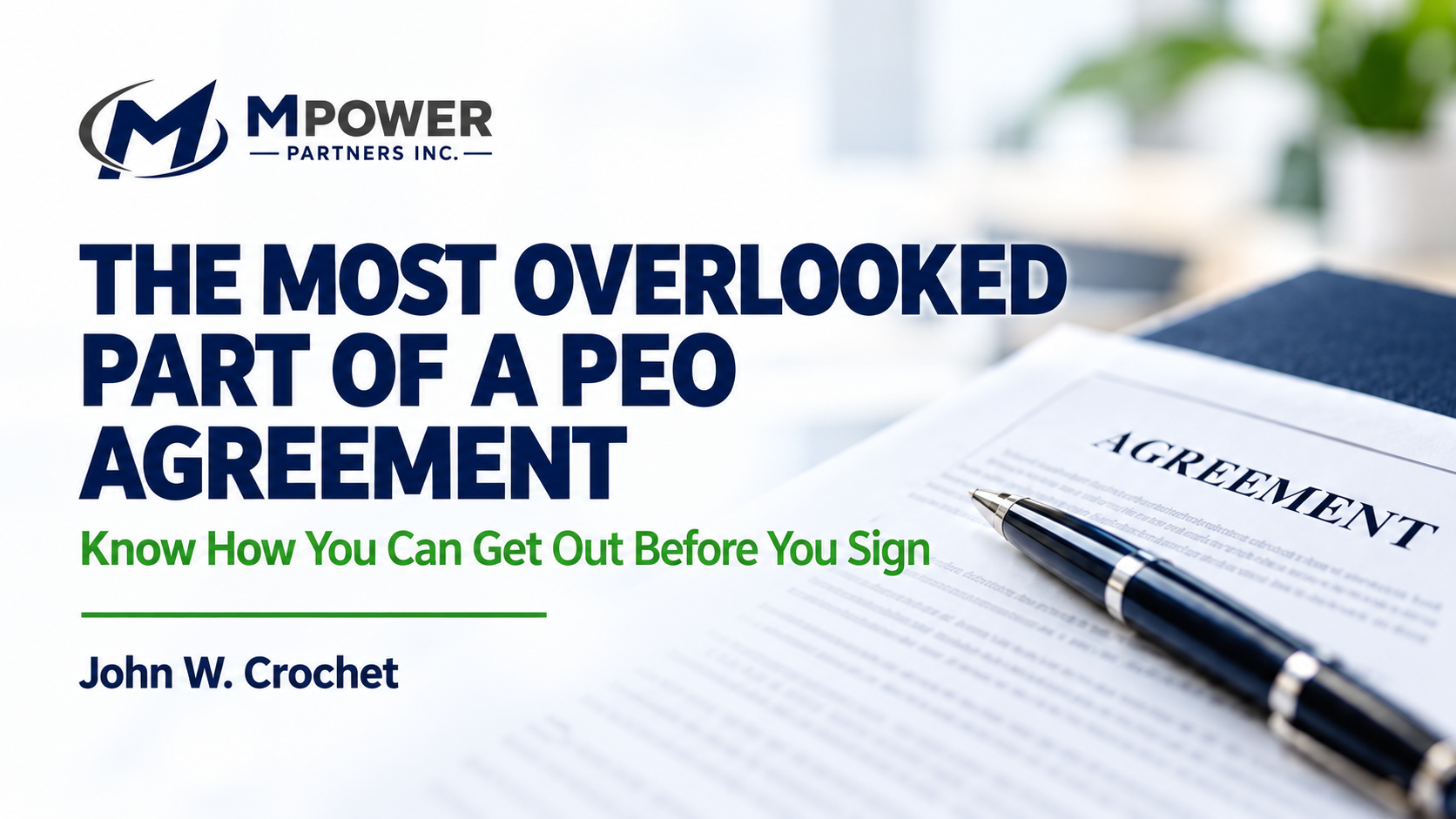
When business owners evaluate a Professional Employer Organization, most of the attention naturally goes to pricing, employee benefits, payroll technology, workers compensation, HR support, and compliance. Those things are important. However, based on my experience helping businesses evaluate and compare PEOs, one of the most important questions is often overlooked: What happens if you want or need to leave? A PEO may refer to its paperwork as a service agreement, client service agreement, or professional employer services agreement. Regardless of the title, it is still a legally binding contract. I have seen business owners spend weeks comparing health plans and administrative fees, only to give very little attention to the provisions that determine how long they are committed, when the agreement renews, and what it may cost to terminate the relationship. In my opinion, the time to understand how you can leave a PEO is before you sign with one. Term The Term section establishes how long the initial agreement remains in effect. Some agreements operate on a monthly basis. Others require a commitment of one year or longer. I never assume that a client can simply leave whenever they choose because they are unhappy with the service. I want to know the exact commitment being made and the date on which that commitment begins and ends. A PEO relationship should be built on performance and value, not on making it unnecessarily difficult for the client to leave. Renewal The Renewal section can be easy to overlook, especially when an agreement renews automatically. A company may believe its agreement ends on a certain date, only to discover that it automatically renewed because the required notice was not provided within a specific period. In my experience, automatic renewal language deserves careful attention. Business owners should know how the renewal works, how much notice is required, and whether there is only a limited window in which notice can be submitted. Missing that window could result in another full contract term. Termination The Termination section explains when and under what circumstances either party can end the relationship. I look for whether the client can terminate without cause simply by providing written notice. I also want to know how much notice is required. Thirty days is very different from sixty or ninety days, especially when the company is dealing with service problems. The agreement may also allow termination for cause. This typically applies when one party fails to meet its contractual responsibilities. However, the definition of cause and the required process can vary considerably. I believe clients should have a reasonable and clearly defined way to exit the relationship if the PEO is not delivering the services that were promised. Default The Default section defines the actions or failures that may be considered a breach of the agreement. A client may be considered in default for failing to fund payroll on time, failing to provide accurate information, or not paying an invoice when required. The PEO may also have responsibilities that could place it in default. I pay close attention to whether the agreement provides an opportunity to correct a problem before the relationship is terminated. This is often called a cure period. The language should be fair to both parties. A minor administrative mistake should not necessarily be treated the same as a serious or repeated failure to perform. Notice This may be one of the most underestimated sections in the entire agreement. A business owner may believe that sending an email to the account manager is sufficient notice of termination. The agreement may require notice to be sent by certified mail to a particular address or delivered to a specific officer of the PEO. If the required procedure is not followed, the PEO may claim that proper notice was never provided. I always recommend determining exactly how notice must be given, who must receive it, and when it becomes effective. Never assume that an ordinary email or telephone conversation satisfies the agreement. Fees The Fees section should be reviewed for more than the regular administrative charge. Some agreements may include early termination fees, minimum fees, final reconciliation charges, benefit-related expenses, or other costs that become due when the relationship ends. I want those potential costs clearly explained before the client signs the agreement. No business owner wants to discover an unexpected termination charge at the same time they are trying to move payroll, benefits, and HR services to another provider. If there is an early termination fee, I believe it should be reasonable, clearly stated, and understood by the client before the agreement is signed. Effect of Termination Ending a PEO relationship involves much more than selecting a final date. Payroll records must be transferred. Tax responsibilities must be identified. Employee benefits may need to be replaced. Workers compensation coverage must remain properly coordinated. Employees must receive accurate information, and the company must maintain access to important records. The Effect of Termination section should explain what each party is responsible for after the relationship ends. I pay particular attention to who will complete outstanding payroll tax filings, how employee data will be returned, when access to the PEO system will end, and whether any obligations continue after termination. A poorly planned transition can affect employees, payroll, benefits, taxes, compliance, and business operations. The agreement should support an orderly transition rather than create additional obstacles. Questions I Believe Every Business Owner Should Ask Before signing a PEO agreement, I would ask: How long is the initial commitment? Does the agreement renew automatically? How much notice is required to terminate? Can the company terminate without cause? What qualifies as a default? Is there an opportunity to correct a problem? Are there any early termination or transition fees? How must notice be delivered? What happens to payroll, employee records, benefits, tax filings, and system access after termination? What assistance will the PEO provide during the transition? These questions should not be treated as an indication that the client expects the relationship to fail. They are simply part of making a responsible business decision. My Personal View I have worked with many PEOs and helped many business owners evaluate their options. I have learned that the quality of a PEO relationship is not determined only by what happens during the sales process. It is also determined by how the PEO performs after the agreement is signed and how fairly it treats the client if the relationship eventually needs to end. I would much rather help a client understand and negotiate these provisions before signing than help them argue about the meaning of the agreement later. A good PEO should be willing to clearly explain its Term, Renewal, Termination, Default, Notice, Fees, and Effect of Termination provisions. If those answers are confusing or difficult to obtain, I believe the business owner should slow down and ask more questions. The right PEO relationship can provide tremendous value. It can improve benefits, strengthen compliance, reduce administrative responsibilities, and allow a business owner to focus more attention on operating and growing the company. But one size does not fit all, and circumstances can change. Understand how the relationship begins, how it operates, and how it ends before you sign. Assume nothing. Ask questions. Keep them honest. Choose wisely, my friends. Choose wisely, my friends. John W. Crochet Founder and President MPower Partners Inc. Independent PEO Broker and Advisor www.mpowerpartnersinc.com
HR consulting ad with smiling man in suit and office team, headline “HR HAS EVOLVED. HAS YOUR BUSINESS?”
By John W. Crochet • October 1, 2026
Discover key lessons from the evolution of HR and PEOs, including changing workplace needs, technology, compliance, and strategies for better employee management.

Book a Service Today