What I Have Learned Watching HR and PEOs Evolve

John W. Crochet • October 1, 2026

When I first became involved in the PEO industry more than 16 years ago, human resources looked very different for most small and midsize businesses.


Payroll was often handled by a bookkeeper or office manager. An insurance agent helped with employee benefits and workers’ compensation. Hiring usually involved an application, an interview, and a handshake.

HR was generally considered an administrative function. It was not viewed as a major part of a company’s business strategy.


I have watched that change dramatically.

Today, business owners must deal with payroll taxes, employee benefits, workers’ compensation, workplace safety, hiring, onboarding, unemployment claims, employee handbooks, and an ever growing list of employment laws and regulations.


Employees also expect more from their employers. They want better benefits, easier access to information, modern technology, career development, and a positive workplace experience.

The owner is still expected to run the business while keeping up with all of it.


That is one of the biggest challenges I see when talking with small and midsize business owners. They did not go into business because they wanted to become experts in payroll, HR compliance, benefits administration, or employment law. They started their companies because they were good at construction, manufacturing, healthcare, hospitality, professional services, oilfield services, or another particular trade or profession.


Yet, as their businesses grew, managing their employees became more complicated and consumed more of their time.


**     Small Businesses Face Big Business Responsibilities     **


Large companies can afford to build entire departments around their workforce. They may have HR managers, payroll specialists, benefits administrators, safety professionals, compliance officers, recruiters, and employment attorneys.


Most small and midsize businesses cannot justify hiring all those people.

Instead, I often see these responsibilities placed on the owner, controller, office manager, or another trusted employee who already has a full-time job.


That person may be perfectly capable, but HR has become too complicated to manage casually.

A payroll mistake can affect every employee. A poorly handled termination can lead to an employment claim. An outdated handbook can create unnecessary risk. A workplace injury can hurt an employee while increasing the company’s workers’ compensation costs.


The business owner still has customers to serve, employees to lead, sales to generate, and cash flow to manage.

I have always believed that an owner’s time should be spent on the parts of the business that only the owner can do. Spending hours trying to solve a payroll problem, understand an employment regulation, or compare benefit plans is rarely the best use of that time.

**     Why PEOs Became an Important Part of the Solution     **


As HR became more complex, Professional Employer Organizations, commonly known as PEOs, became an increasingly important option for small and midsize businesses.


Before founding MPower Partners in 2011, I worked directly for a PEO. That experience gave me an inside look at how the PEO relationship works and the value it can provide.


It also taught me something equally important. One PEO cannot be the right answer for every business.

A PEO can bring payroll, HR support, employee benefits, workers’ compensation, safety, compliance assistance, and technology together through one relationship.


Depending on the PEO and the needs of the company, the services may include:


  • Payroll processing and payroll tax administration
  • Human resources guidance
  • Employee benefits
  • Workers’ compensation
  • Workplace safety and risk management
  • Employment compliance assistance
  • Recruiting and onboarding tools
  • Time and attendance systems
  • Employee training
  • Retirement plan options
  • Employee handbooks, policies, and procedures


The business owner continues to run the company, supervise employees, and make business decisions. The PEO supports the employment responsibilities that can otherwise consume the owner’s time.


Over the years, I have seen the right PEO relationship transform how a business handles its people.


Instead of calling several unrelated vendors and hoping they communicate with one another, the business has access to an integrated team and system. Instead of relying on one overwhelmed employee to know everything about HR, the company can call experienced professionals for help.


That support can be especially valuable when something unexpected happens. That is usually when a business discovers whether its HR provider is truly a partner.


The Right PEO Can Be More Cost-Effective Than Doing Everything Yourself


Business owners sometimes look at the PEO’s fee and assume outsourcing must be more expensive than handling everything internally.


In my experience, that comparison is often incomplete.


The real question is not simply, “What does the PEO charge?”


The better question is, “What is our total cost of managing HR?”


That includes payroll processing, benefits administration, workers’ compensation, HR technology, safety resources, compliance support, internal employee time, and the time owners and managers spend resolving employment problems.


It can also include the cost of mistakes.


Hiring a payroll specialist, HR manager, benefits administrator, recruiter, safety professional, and compliance expert would be expensive for most smaller businesses. A PEO may give the company access to all those resources without requiring it to hire each specialist directly.


The right PEO may also help a business obtain better employee benefits, manage workers’ compensation more predictably, improve workplace safety, and give employees better technology and support.


Sometimes the most valuable savings do not appear as a line item on a proposal. They come from avoiding problems, reducing administrative work, improving employee retention, and allowing the owner to focus on growing the business.


**     I Learned Early That Bigger Is Not Always Better     **


When I founded MPower Partners, I made the decision to work independently rather than represent one PEO.


I made that decision because I had already learned that businesses are different, and PEOs are different.


A large national PEO may be the best choice for one company but a poor fit for another. A smaller regional PEO may provide exceptional service for a particular industry or location. One PEO may be strong in employee benefits, while another may be better equipped for workers’ compensation, high-risk industries, businesses operating in several states, or specialized technology.


Bigger is not always better.


I have worked with companies in construction, oilfield services, manufacturing, hospitality, home healthcare, staffing, logistics, professional services, and many other industries. Their needs are not interchangeable.


A PEO that works well for a professional office may not be equipped to support an oilfield service company, construction contractor, or staffing company.


That is why I begin by learning about the business instead of promoting a particular PEO.


How many employees does the company have? Where do they work? What type of work do they perform? What are the company’s benefit needs? What challenges is it experiencing with payroll, workers’ compensation, compliance, safety, or service?


Only after understanding the business can I determine which PEOs should be considered.


One size does not fit all.


**     Price Matters, but So Does Everything Behind the Price     **


I have reviewed many PEO proposals over the years, and one lesson continues to stand out. The lowest number on the page is not always the lowest total cost.


Some proposals appear inexpensive because important charges are presented differently, excluded, or difficult to identify. Others may look attractive initially but become much more expensive at renewal.


Service also matters.


A low price loses its appeal quickly when payroll problems are not resolved, calls are not returned, benefits are poorly administered, or the technology does not meet the company’s needs.


I tell business owners to understand exactly what is included, what is not included, how workers’ compensation is calculated, how benefits are priced, and what can change later.


Assume nothing.


When PEOs compete for the same business, the owner gains a much clearer picture of the marketplace. Competition can improve pricing, service commitments, and contract terms.


When PEOs compete, you win.


* *     Companies Already Using a PEO Should Keep Evaluating the Relationship     **


My work is not limited to companies considering a PEO for the first time.


I also help businesses that are already using a PEO determine whether their current provider is still the right fit.


Businesses change. PEOs change. Pricing changes. Benefit plans change. Service teams and technology change.


A PEO that was the right choice several years ago may still be the best option. The business should not simply assume that it is.


I have seen situations where a current PEO suddenly became willing to improve its pricing after learning that the client was evaluating other options. That always raises an important question. If the PEO can offer better pricing now, why was the client not receiving it before?


Sometimes changing providers makes sense. Sometimes staying with the current PEO after renegotiating the relationship is the better decision.


My goal is not to move a company simply for the sake of moving it. My goal is to help the owner make an informed decision.


Sometimes you have to keep ’em honest.


**     The Best HR Solution Gives the Owner Time Back     **


After more than 16 years in this industry, I believe the greatest value of the right PEO relationship is not simply payroll, benefits, technology, or compliance support.


It is time.


Time to take care of customers.


Time to lead employees.


Time to pursue new opportunities.


Time to focus on the work that made the business successful in the first place.


A PEO will not operate the business for you, and it will not eliminate every employment challenge. The right PEO can provide the support, resources, and guidance that allow a small or midsize business to operate more like a much larger company.


I do not work for one PEO. I work for the business owner.


I help businesses evaluate their needs, compare qualified PEOs, understand proposals, negotiate the relationship, and select the provider that best fits their needs. There is no cost or obligation to the business for my assistance, and I remain available as an advocate after the PEO is selected.


HR has evolved, and business owners have more choices than ever before.


The key is knowing which choice is right for your business.


Choose wisely, my friends.


John W. Crochet
Founder and President
MPower Partners Inc.
Independent PEO Broker and Advisor
www.mpowerpartnersinc.com


You might also like
By John Crochet • April 28, 2026
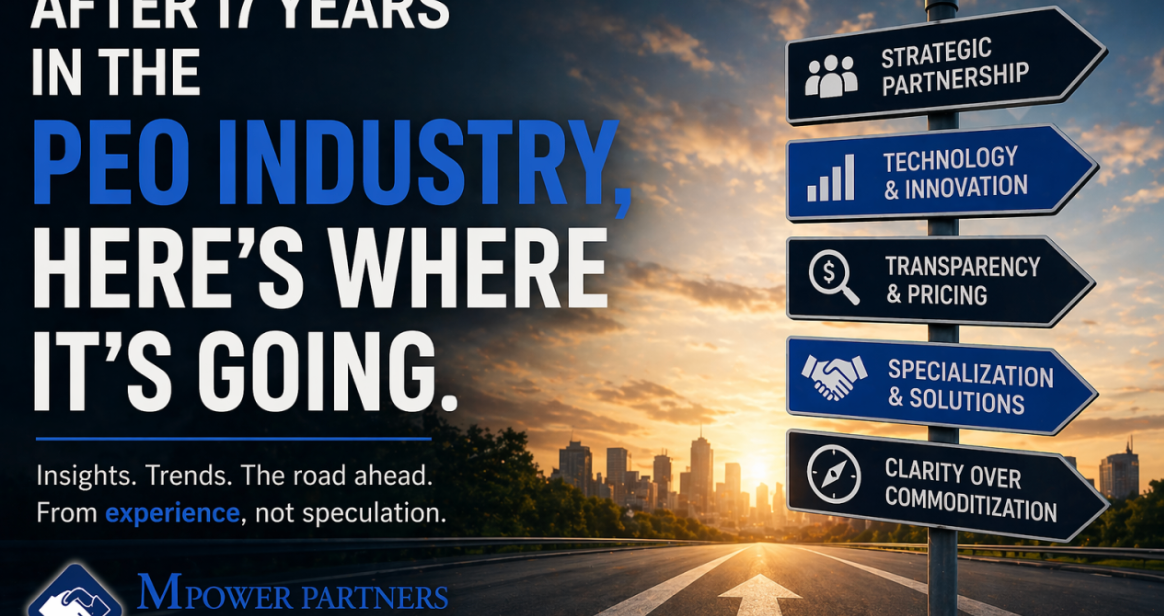
The PEO industry isn’t going anywhere. In fact, it’s growing. But growth doesn’t always mean improvement. Over the next 3 to 5 years, the PEO space is going to become more crowded, more competitive, and more confusing for the very businesses it’s supposed to help. Let me explain. The Industry Is Growing… But So Is the Noise More PEOs. More brokers. More posts. More promises. From the outside, it’s starting to look like everyone offers the same thing: Payroll, benefits, HR, compliance. Different logos. Same message. And when everything sounds the same… Decision-making gets harder, not easier. The Shift from Vendor to Partner The days of “just run payroll and handle HR” are fading. Today’s businesses need more: Guidance on rising healthcare costs Help navigating compliance Support with hiring and retention Technology that actually works The PEOs that win in the future will not be the ones that sell the most. They will be the ones who operate the best and advise the strongest. Technology Will Separate the Good from the Great AI and HR tech are raising expectations quickly. Clients want: Real-time data Clean reporting Seamless systems The gap between modern platforms and outdated ones is widening. 👉 Some PEOs will evolve. 👉 Others will get exposed. Pricing Transparency Is Coming For years, the industry has leaned on bundled pricing. One number. All included. Don’t ask too many questions. That’s changing. More business owners are starting to ask: What am I really paying for workers’ comp? What are the actual benefit premiums? How much is the admin fee vs. everything else? And when those questions get asked… 👉 Things start to surface. Consolidation Will Continue Private equity and acquisitions are not slowing down. Larger PEOs will continue to grow through acquisition. But here’s the tradeoff: Bigger doesn’t always mean better Service can suffer Pricing discipline tightens This creates an opportunity for: ] Niche PEOs Regional providers Independent advisors The Market Is Fragmenting There is no longer a “one size fits all” PEO. You’ll see more specialization: Industry-focused providers Risk-specific solutions Hybrid models combining PEO and open market options Which sounds great… until you’re the business trying to figure out which one is right. The Biggest Risk: Commoditization The biggest threat to the industry is not regulation. It’s not competition. It’s commoditization. When decisions are made based on: Lowest admin fee Familiar name Who showed up first 👉 The wrong decisions get made. And when that happens, businesses don’t just overpay… They underperform. Where This Is Headed Over the next few years, the PEO industry will split into two clear paths: The Leaders Transparent pricing Strong operations Consistent service Advisory-driven approach The Biggest Risk: Commoditization The biggest threat to the industry is not regulation. It’s not competition. It’s commoditization. When decisions are made based on: : Lowest admin fee Familiar name Who showed up first 👉 The wrong decisions get made. And when that happens, businesses don’t just overpay… They underperform. Where This Is Headed Over the next few years, the PEO industry will split into two clear paths: The Leaders Transparent pricing Strong operations Consistent service Advisory-driven approach The Rest Price-driven selling Opaque structures Inconsistent delivery High turnover on service teams The Role of the Independent Advisor As the market gets louder and more complex… clarity becomes more valuable. That’s where independent advisors come in. Not to sell a PEO. But to: Break down the numbers Compare real options Keep providers honest Help businesses make informed decisions Final Thought The PEO industry is a powerful solution when it’s done right. But in a market full of noise, growth, and competing messages… 👉 The real advantage will not come from choosing a PEO. 👉 It will come from choosing the right one for the right reasons. John Crochet, Independent PEO Advisor, MPower Partners, Redefining HR Solutions
By John Crochet • January 17, 2025
As a small or mid-sized business (SMB) leader, you juggle many responsibilities, and HR compliance is likely one of the most complex. The web of federal, state, and local regulations can be overwhelming. Yet, staying compliant isn’t optional, protecting your business from penalties, lawsuits, and operational disruptions is essential. Let’s explore some common HR risk and compliance issues you may encounter and how to address them effectively. Common HR Risk and Compliance Challenges Recruiting for an Open Position Complying with anti-discrimination laws, such as Title VII of the Civil Rights Act, is crucial during the hiring process. Employers must avoid biases based on race, gender, age, or other protected categories. Fair Labor Standards Act (FLSA) The FLSA sets minimum wage, overtime, and recordkeeping standards. Misclassifying employees as exempt or non-exempt can lead to significant legal trouble. Onboarding a New Hire I-9 verification, tax documentation, and providing mandatory notices (such as workers' compensation information) are just a few onboarding requirements to consider. Providing Employee Benefits The Affordable Care Act (ACA) mandates that businesses meeting certain criteria offer health insurance to employees. Non-compliance can result in hefty penalties. Issuing W-2s and Meeting IRS Deadlines The IRS requires accurate and timely filing of W-2 forms for all employees. Missing deadlines can result in fines. Offering a Retirement Plan The Employee Retirement Income Security Act (ERISA) sets standards for retirement plan administration and fiduciary responsibilities. Mismanagement can lead to compliance violations. Reacting to a Workplace-Related Injury OSHA requires that workplace injuries be properly recorded and reported. Failure to comply can lead to fines and increased scrutiny. Handling Leave Requests Laws like the Family and Medical Leave Act (FMLA) and various state-specific leave regulations require proper handling of leave requests, including those for maternity or medical reasons. Providing Bonuses The IRS governs how bonuses must be taxed. Mismanagement of bonus taxation can lead to penalties for both employers and employees. Paying a Departing Employee The FLSA, along with state laws, dictates when final paychecks must be issued. Late or incomplete payments can trigger legal action. What Does HR Compliance Do? HR compliance ensures your business adheres to all applicable employment laws and regulations. It safeguards your company from financial risks, protects your employees’ rights, and fosters a positive workplace culture. How Do You Ensure HR Compliance? Ensuring HR compliance begins with awareness of the laws and regulations that apply to your business. Here’s how you can stay on track: Create an HR Compliance Checklist Develop a detailed checklist covering all critical areas of compliance, including recruiting, onboarding, payroll, benefits, workplace safety, and termination processes. Develop an HR Compliance Strategy Embed compliance into your company’s culture and processes. Regularly update your policies to reflect changes in the law and provide training for your staff. Invest in HR Technology Modern HR technology and human capital management (HCM) systems can streamline compliance efforts by automating recordkeeping, tax filings, and benefits administration. However, these systems can be costly for SMBs. How a PEO Can Help with HR Compliance Engaging a Professional Employer Organization (PEO) can be a game-changer for SMBs. When you partner with a PEO, you gain access to: Integrated HR Technology State-of-the-art systems improve compliance, boost productivity, and streamline processes from hire to retire, all while offering self-service features for employees. Expert HR Guidance PEOs provide access to a team of HR professionals who offer tailored advice on regulatory compliance, reducing your risk and workload. Cost-Effective Solutions With a PEO, SMBs can leverage enterprise-level resources at a fraction of the cost, ensuring compliance without breaking the bank. Gain Peace of Mind with MPower Partners At MPower Partners, we specialize in helping SMBs find the right PEO that understands your industry and unique needs. We’ll guide you to a solution that ensures compliance, streamlines operations, and frees you to focus on growing your business. Reach out to us today to explore how a PEO partnership can give you peace of mind and more time to lead your business with confidence. www.mpowerpartnersinc.com
By John Crochet • January 10, 2025
Questions to Evaluate When Assessing Your PEO Choosing a new Professional Employer Organization (PEO) is a significant decision, and switching PEOs without identifying the root issues can lead to recurring problems. It can also result in wasted time, money, and effort. Before making a move, it’s crucial to evaluate your current PEO arrangement. Here are key questions to guide your evaluation: 1. Am I Getting the Best Price I Can Get? This is often the first question businesses ask, but it’s also one of the most challenging to answer. Pricing in the PEO industry can be complex, with bundled services and varied fee structures. Conducting an annual PEO evaluation can help confirm if you’re getting competitive pricing or if adjustments need to be made. Even if you stay with your current PEO, this review can provide leverage for negotiating better terms. 2. Does My PEO Respond to My Needs Promptly? Surprisingly, many businesses cite the availability and responsiveness of their PEO’s HR representative as a major pain point. A strong PEO-client relationship relies on effective communication. Evaluate whether your PEO is quick, responsive, and proactive in addressing your needs. If not, it might be time to reconsider your provider. 3. Do I Need Better Accounting Features? Modern PEOs use advanced technology and software to streamline processes. These tools save time and money, which is one of the primary reasons for partnering with a PEO. If your PEO’s accounting features are outdated or inefficient, you may not be receiving the value you expect. 4. Is My Billing Transparent and Understandable? Do you know exactly how your PEO fees are calculated and what services you’re paying for? If your billing is unclear, it’s easy to overpay for unnecessary services. Ensure your PEO provides clear and detailed billing statements to help you track costs accurately. 5. Am I Taking Advantage of All the HR Services I’m Paying For? Sometimes, companies purchase a suite of PEO services but fail to use them all. Identify your business’s specific needs and consider whether you’re fully utilizing the services you’re paying for. If not, explore the option of selecting services a la carte to better align with your goals. 6. Does My PEO Help My Business Operate More Efficiently? If your PEO is causing more headaches than solutions, it’s time to reevaluate. The goal of partnering with a PEO is to simplify HR and administrative processes, not add unnecessary complexity. 7. Does My PEO Make a Lot of Mistakes? Mistakes in payroll, compliance, or documentation can be costly and damaging. A reliable PEO minimizes risk and ensures compliance. If your current provider consistently makes errors, it’s a clear sign you need a change. Common Concerns Businesses Have About Their PEO Here are a few of the most frequent issues businesses face with their PEOs: I want more efficiency. I want better communication and responsiveness. I want to ensure I have the best pricing. I am unhappy with payroll technology. There are too many mistakes. We are not using all the services we’re paying for. I want billing transparency. I need better accounting features. I want a local HR representative. I want to save on health insurance costs. I want to cut costs/fees or see where I can save. The Value of an Annual PEO Evaluation An annual PEO evaluation is a powerful tool to ensure your provider aligns with your business’s needs. It can help you: Confirm if you’re partnered with the right PEO. Identify areas for cost savings and improved service. Provide a strategy for negotiating better terms or transitioning to a new PEO if necessary. Conclusion Partnering with the right PEO is essential to streamlining your business operations and reducing costs. However, without proper evaluation, you risk facing the same issues repeatedly. By asking these questions and conducting regular reviews, you’ll ensure your PEO partnership drives value and supports your business’s goals. If you’re considering a PEO evaluation or need guidance on finding the best PEO for your needs, I’d be happy to help. Let’s discuss how you can optimize your HR and administrative processes for greater success.

Book a Service Today